
Sanskrit is a big part of the Maharashtra State Board syllabus that, apart from enhancing students’ language skills, also enlightens them about the literature of India through time.
In Grade 9, students are introduced to more challenging grammar rules, vocabulary, and a text-based approach to learning, which often requires additional support. The Navneet Sanskrit Digest for 9th Standard is designed to help learners by providing lesson-wise explanations of grammar in simple, easy-to-understand language.
Why Sanskrit Grammar Feels Harder Than It Needs To Be
Most Class 9 students are meeting formal Sanskrit grammar — declensions (vibhakti), verb conjugations (lakar), and sandhi rules — at a level of real depth, mostly for the first time. When such topics are explained through technical, heavy explanations far removed from the lesson text, students only remember rules they don’t really know how to use.
The outcome is obvious: good scores on grammar exercises done separately, poor scores when test questions on translation or sentence construction require using that same grammar in an unfamiliar sentence.
What Is the Navneet Sanskrit Digest for 9th Standard?
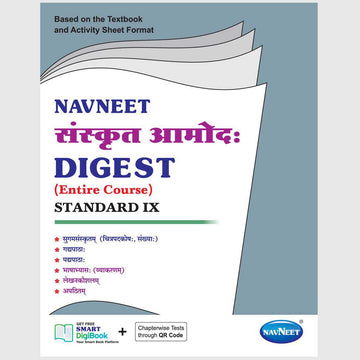
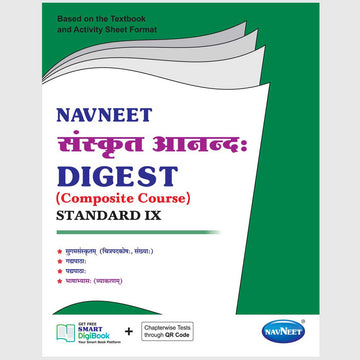
The 9th std Sanskrit digest is a supplementary study guide based on the Class 9 Sanskrit textbook of Maharashtra State Board, published in both Anand and Amod editions based on the syllabus level of a student’s school.
Being a digest published by Navneet, its material closely follows the board’s latest syllabus and chapter order — rather than merely providing a generally related Sanskrit grammar guide.
The Core Idea: Grammar Taught Inside the Lesson, Not Beside It
Here is the biggest difference between this digest and a usual grammar workbook. A typical grammar book puts all declension rules in one chapter and all verb forms in another. The 9th Sanskrit digest instead discusses grammatical points of each lesson at the very place those points appear within that lesson — tied to the very shlokas and sentences students are reading.
A student working on a particular lesson proceeds through:
The grammar rule itself: Laid out in everyday language so that even without prior grammatical terminology, the student understands.
A direct example from that lesson: Illustrating the rule through the very text being studied — not some random textbook example.
Immediate reinforcement: The grammar point and its use are learned concurrently, rather than as two separate, unrelated tasks.
Everything Inside the Digest, at a Glance
Salient Features
| 1.Revised and updated in accordance with the latest pattern कृतिपत्रिका released by the Board. |
| 2.Meanings of difficult words in Prose and Poetry lessons. |
| 3.Lesson-wise explanation of grammatical points in simple language. |
| 4.Literal translation of prose and poetry lessons and the prose order of verses. |
| 5.Answers to all textual questions included in Exercises (स्वाध्यायमाला). |
| 6.Additional कृतियाँ framed exactly in accordance with those given in the section भाषाभ्यासः in the Board’s कृतिपत्रिका. |
| 7.Special guidance for all the कृतियाँ in the section लेखनकौशलम्. |
Building Real Translation Skill, Not Just Memorised Answers
Translation is the point at which Sanskrit grammar and vocabulary truly unite. It is also the point at which many students resort to simply memorising the textbook’s English meanings without grasping how the Sanskrit sentence conveys that meaning.
The digest’s word-to-word translation method, together with the prose-order layout of verses, guides students in seeing how each word adds to the sentence — following the natural logical order rather than the poetic word order of the original shloka.
This is very important for exams since translation and word-meaning questions reward true understanding, which memorised English sentences cannot replicate when the question is even slightly rephrased.
Practice That Matches the Board’s Current Question Style
Besides explanations, the digest also consists of translation-type questions, grammar practice sets, additional question-answers, and Competency Based Questions (CBQs) — a question type increasingly used in Maharashtra Board’s present paper pattern. CBQs check if a student can apply a concept in a somewhat new context, which is precisely the ability that lesson-wise, application-based grammar teaching aims to develop.
A Word on PDF Searches
It’s common to search for a Sanskrit digest std 9 PDF when quick, on-the-go access feels more convenient than carrying a physical book. But unverified PDFs found online are often outdated, mismatched to the wrong edition (Anand vs. Amod), or missing sections entirely — which can do more harm than good right before an exam. For dependable, edition-accurate content, the physical Navneet digest from an authorised bookstore remains the safer choice.
A Practical Way to Use This Digest Through the Term
|
||
|
||
|
Browse All Navneet Std 9 Maharashtra Board BooksAll subjects, both mediums — find every Std 9 digest on Navneet Store. |
Final Thoughts
Sanskrit doesn’t have to be the subject students brace themselves for. When grammar is taught lesson-wise, in simple language, and tied directly to the text being studied, the language stops feeling like a memorisation exercise and starts feeling learnable. Visit your nearest bookstore today and purchase authentic Navneet books to support your child’s academic journey, or buy the full range of Class 9 Digests on the Navneet Store.
FAQs About Navneet Sanskrit Digest for 9th Standard
|
||
|
||
|
||
|
||
|
||
|
||
|