
OCM — Organisation of Commerce and Management — is the subject that catches most Commerce stream students off guard in their first HSC semester. The content isn’t conceptually difficult, but it is term-heavy: each chapter introduces definitions, features, merits and demerits, and distinctions that the exam tests repeatedly and specifically. Students who treat OCM as a “reading subject” and don’t drill exact terminology consistently lose marks that are entirely available to them.
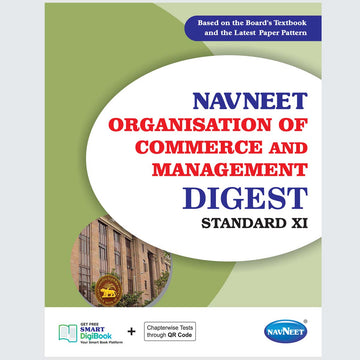
The Navneet OCM Digest for Std 11 is built around this reality — Key Terms and Their Meanings as a ready-reference section in every chapter, comparison charts, chapter summaries, and model question papers for both the First Semester (50 marks) and Annual Examination (80 marks).
What Is OCM and Why Does It Matter?
Organisation of Commerce and Management (OCM) is a core subject for Commerce stream students in the Maharashtra HSC syllabus. Introduced formally at Std 11, it covers the fundamental concepts of how businesses are organised, the different forms of business ownership, the role of supporting institutions, the business environment, and the principles and functions of management.
OCM matters for two reasons beyond exam marks: first, it builds the conceptual foundation for Std 12 OCM, which builds directly on Std 11 content — students who understand OCM well in Std 11 require significantly less new learning in Std 12. Second, for students considering careers in business, management, or entrepreneurship, OCM introduces the vocabulary and frameworks that underpin those fields.
What’s Inside the Navneet OCM Digest?
Chapter-wise Overview: All 8 Chapters
Chapter 8 (Introduction to Management) and Chapters 4–5 (Forms of Business Organisation) are the most frequently tested chapters for long-answer, definitions, and distinctions. These chapters together carry the heaviest weight in both the Semester 1 and Annual examination papers.
Why Key Terms Are the Core of OCM Exam Prep
The OCM exam tests terminology very directly — definitions of terms like “management”, “co-operative society”, “sole proprietorship”, “business environment” are asked for verbatim or near-verbatim answers. Students who can reproduce a precise, well-worded definition score full marks on these; students who paraphrase loosely often score one or two marks less per question.
The same applies to “features” and “characteristics” — questions asking for 3 or 5 features of a concept are standard exam fare. The digest presents these as numbered points exactly as the board expects them to appear in an answer. Students who study them in this format are already practising the answer structure, not just the content.
“Distinguish between” questions are equally common — Sole Proprietorship vs Partnership, Joint Stock Company vs Co-operative Society, Internal vs External Business Environment. The digest’s comparison charts present these in a ready-to-use format that students can practise reproducing under exam conditions.
Browse All Navneet Std 11 Maharashtra Board DigestsOCM, English, Economics, Accounts, Physics and more — all stream-specific HSC Part 1 digests on Navneet Store. |
How to Use This Digest Effectively
|
||
|
||
|
||
|
||
|
Final Thoughts
OCM is one of those subjects where the gap between understanding and scoring is almost entirely closed by terminology and format practice. Students who know the definitions, features, and distinctions in the board’s expected format consistently outperform those who understand the subject but write loosely worded answers. The Navneet OCM Digest for Std 11 is built to close that gap. Check current availability at Navneet Store or at your nearest authorised retail partner.
FAQs About Navneet OCM Digest for 11th Standard
|
||
|
||
|
||
|
||
|