
English in HSC Part 1 is a subject that students across all three streams — Arts, Commerce, and Science — tend to either take for granted or leave until the last month. Both approaches cost marks. The paper is highly predictable: poem appreciation, prose Q&A, writing skills (blog, e-mail, film review, comparison), and grammar. Students who learn the format early and practise each component consistently through the year consistently outscore those who rely on last-minute cramming.
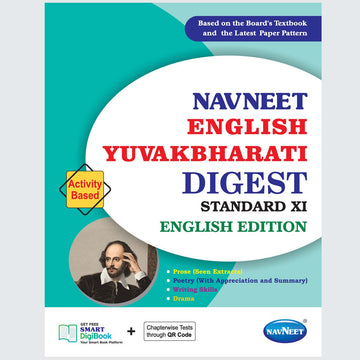
The Navneet English Yuvakbharati Digest for Std 11 is built for exactly this — covering all sections of the Maharashtra HSC Part 1 English syllabus with poem appreciations, writing skill models, non-textual passage practice, Ice Breaker/Brainstorming guidance, and the Board’s Model Activity Sheet included.
What Is the Navneet English Digest for Std 11?
The Navneet English Yuvakbharati Digest for Std 11 is a comprehensive revision companion for the Maharashtra HSC Part 1 English syllabus. It is aligned to the Balbharati Yuvakbharati textbook and the current Maharashtra HSC exam Activity Sheet format — covering Prose, Poetry, Writing Skills, Drama, and Non-Textual Passages in a single volume.
One digest for all three streams: the Std 11 English syllabus is uniform across Arts, Commerce, and Science in Maharashtra. There is no separate Commerce edition or Science edition — one digest covers all streams.
Key features at a glance: Ice Breakers and Brainstorming activity guidance, poem paraphrase, appreciation and summary for all 6 poems, division into extracts per the Activity Sheet format, blue patch activity coverage, writing skills sections for new topics (blog, e-mail, film review, comparing), drama synopses in simple language, non-textual passages for comprehension, summary, note-making, and mind mapping, and the Board’s Model Activity Sheet for practice.
Chapter-wise Overview: All Sections
Poem Appreciation: The 7-Point Framework
Poem appreciation is consistently the most mark-heavy and most mishandled section of the HSC English paper. Students who understand the poem’s meaning but don’t know the expected format — what to write, in what order, at what length — consistently underperform relative to their actual understanding. The digest provides model appreciations for all 6 poems in the following format:
| 1. Title and Poet: Identify the poem and its author — the opening line of every appreciation. |
| 2. Central Idea: State the main theme or message in 2–3 sentences — what the poem is fundamentally about. |
| 3. Tone and Mood: Describe the emotional register — is it celebratory, melancholic, contemplative, ironic? This is where appreciations begin to differentiate. |
| 4. Poetic Devices: Identify and explain at least 3–4 figures of speech with examples from the poem — simile, metaphor, personification, alliteration, repetition. |
| 5. Structure: Comment on rhyme scheme, stanza pattern, and verse form — even noting free verse is a valid structural observation. |
| 6. Favourite Lines: Quote (briefly) and explain two lines that you find most impactful — this is where personal engagement shows. |
| 7. Special Message: Conclude with what the poem conveys to the reader today — the relevance of its theme. |
The digest provides complete model appreciations for each of the 6 poems in the Yuvakbharati syllabus using this framework — giving students a benchmark to assess and improve their own writing against before the board exam.
Arts, Commerce or Science: Which Edition Do You Need?
All three streams follow the same Maharashtra HSC Part 1 English syllabus — the Balbharati Yuvakbharati textbook. This means the Navneet English Yuvakbharati Digest for Std 11 covers Arts, Commerce, and Science students in a single edition. There is no separate Commerce edition or Science edition. Students searching for an “11th commerce English digest” or “11th science English digest” need the same digest.
What does differ by stream at Std 11 level are the other subjects — Physics, Chemistry, Biology, Economics, Accounts, etc. — for which Navneet produces stream-specific digests.
Browse All Navneet Std 11 Maharashtra Board DigestsEnglish, Physics, Chemistry, Biology, Maths, Commerce subjects — all stream-specific HSC Part 1 digests on Navneet Store. |
Year-long Study Plan
|
||
|
||
|
||
|
Final Thoughts
English in HSC Part 1 is fully scoreable for students who respect it as a format-learning subject. The poem appreciation framework, the writing skills formats, the non-textual passage approach — these are all learnable patterns that reward consistent early practice. The Navneet English Yuvakbharati Digest for Std 11 provides those patterns with model answers for every section. Check current availability at Navneet Store or at your nearest authorised retail partner.
FAQs About Navneet English Digest for 11th Standard
|
||
|
||
|
||
|
||
|