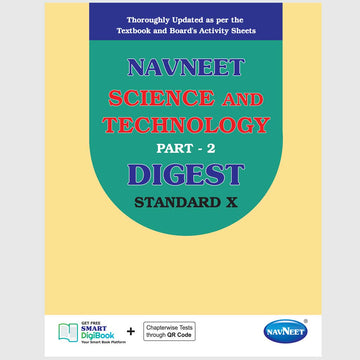
Science is a very significant subject in the curriculum of class 10 that mainly focuses on understanding concepts, memorising main points, and utilising the acquired knowledge during exams. Chapters included in Science 2, like heredity evolution, human life and environmental management, may contain extensive descriptions and technical words.
The Science 2 digest std 10 by Navneet aims to make learning easy and fun through chapter-wise summarisation, memory maps, and well-organised solutions. Students who are either looking for a std 10 Science 2 digest PDF for their revision or want exam-oriented study materials.
What Exactly Is the Navneet Science 2 Digest, and Why Does It Sit on Every Topper’s Desk?
The Navneet Science and Technology Part 2 Digest is a supplementary book to the Balbharati textbook and helps with the biology and environmental science segments of the Std 10 syllabus, like chapters on Heredity and Evolution, Life Processes in Living Organisms, Cell Biology and Biotechnology, and Environmental Management.
Navneet has been making it easier for board exam students in Maharashtra and Gujarat to prepare for their exams for more than sixty years now, and this same mentality is reflected in the Science 2 digest std 10: the aim is to take a chapter that usually reads like a scientific paper into a short and effective revision for a 15-year-old almost the night before the exam.
Inside the Digest: Features That Actually Help You Score, Not Just Read
Here is what makes this digest different from a plain set of notes:
| Digest Feature | What It Includes |
| Latest Board Activity Sheet Pattern | Fully revised according to the latest Maharashtra State Board Activity Sheet pattern. |
| Chapter Outline & Important Points | Chapter-wise outlines and key points at the beginning of every chapter for quick understanding. |
| Textual & Additional Questions | Model answers to all textbook questions, along with additional practice questions in every chapter. |
| HOTS & Thinking Skills | Model answers for Higher Order Thinking Skills (HOTS) questions, including ‘Use Your Brain Power!’ and ‘Think About It!’ activities. |
| Activity-Based Question Support | Complete answers to activity-based questions, including ‘Try This’ exercises. |
| ‘Can You Tell?’ & ‘Can You Recall?’ Answers | Detailed answers to ‘Can You Tell?’ and ‘Can You Recall?’ questions in every chapter. |
| Memory Maps | Chapter-end memory maps for quick revision and easy recall of important concepts. |
| Scientific Diagrams | Scientifically accurate and well-labelled diagrams are provided wherever required. |
| Board Activity Sheet Practice | Includes the latest Maharashtra State Board Activity Sheet with appropriate answers for effective exam preparation. |
Memory Maps & Summaries, Chapter by Chapter
Since the title promises memory maps in every chapter, here is where they make the biggest difference across the Science Part 2 syllabus:
| Chapter | Topic Covered |
| 1. Heredity and Evolution | Explains the principles of heredity, genetic variation, evolution, and the evidence supporting evolutionary changes. |
| 2. Life Processes in Living Organisms – Part 1 | Covers nutrition, respiration, transportation, and excretion in living organisms. |
| 3. Life Processes in Living Organisms – Part 2 | Focuses on control and coordination, reproduction, and the continuity of life. |
| 4. Environmental Management | Introduces environmental conservation, sustainable development, biodiversity, and waste management. |
| 5. Towards Green Energy | Explains renewable energy sources, energy conservation, and the importance of sustainable energy practices. |
| 6. Animal Classification | Describes the classification of animals based on their characteristics and evolutionary relationships. |
| 7. Introduction to Microbiology | Covers microorganisms, their classification, uses, and their role in health, industry, and the environment. |
| 8. Cell Biology and Biotechnology | Explains cell structure, biotechnology, genetic engineering, and their applications in various fields. |
| 9. Social Health | Discusses physical, mental, and social health, lifestyle choices, and measures for maintaining well-being. |
| 10. Disaster Management | Introduces different types of disasters, disaster preparedness, mitigation, and safety measures during emergencies. |
Aligned with the Latest Pattern of the Board’s Activity Sheet
The Maharashtra State Board’s Science and Technology Part 2 paper for SSC is set for 100 marks, split across multiple-choice questions, descriptive answers, and marks for practical work and internal assessment. The Navneet std 10 Science 2 digest PDF and printed editions are revised to reflect this exact structure, including actual Board Activity Sheets from previous exam cycles, so students practice writing answers in the same format they will see on exam day rather than guessing at it.
Searching for a ‘Std 10 Science 2 Digest PDF’? Here’s the Smarter Way to Look
A large number of students search for a 10th Science 2 digest PDF hoping for a free, quick download. The trouble is that most unofficial PDFs circulating online are outdated, missing the latest Board’s Activity Sheets, or stripped of the labelled diagrams and memory maps that make the original digest useful in the first place. For a subject where diagram labelling and exact terminology earn marks, an incomplete or outdated copy can do more harm than good during revision.
Where to Find an Authentic Copy
The safest way to get a genuine 10th std science 2 digest PDF or printed edition is directly through Navneet’s own channels. You can browse the full range of Std 10 digests, including Science and Technology Part 1 and Part 2, on the Navneet eCatalogue, or learn more about Navneet’s complete range of board-aligned study material at navneet.com. Buying from verified sources also means you are getting the latest edition, updated for the current academic year’s syllabus and activity sheet pattern.
Quick Tips to Get the Most Out of Your Digest
- Read the chapter in your textbook first, then use the digest’s Outline Important Points to check what you remember.
- Redraw each chapter’s memory map from memory once, rather than just reading it — recall beats re-reading.
- Attempt the included Board’s Activity Sheets under timed, exam-like conditions, not as casual reading.
- Use the chapter-wise summaries for your final 48-hour revision instead of going back to the full textbook.
- Keep a separate page for diagrams you keep mislabelling — repetition fixes this faster than rereading the explanation.
FAQs About Navneet Science 2 Digest for 10th Standard
1. What is included in the Navneet Science 2 Digest for Std 10?
It includes chapter outlines, memory maps, chapter-wise summaries, solved textual and HOTS questions, labelled diagrams, and previous years’ Board’s Activity Sheets for the Science and Technology Part 2 syllabus.
2. Is the science 2 digest std 10 available in English, Marathi, and Semi-English medium?
Yes, Navneet publishes its Std 10 digests across multiple mediums of instruction to match what is taught in different Maharashtra Board schools. Check the NavneetStore.com for the medium-specific edition you need.
3. Does the digest cover the entire Science and Technology Part 2 syllabus?
Yes every chapter from Heredity and Evolution through to Disaster Management is covered, each with its own outline, summary, and memory map.
4. Where can I get a genuine 10th science 2 digest pdf or printed copy?
You can purchase the latest edition of the 10th Science 2 Digest online from NavneetStore.com, or buy it from your nearest bookstore the official store for genuine Navneet study materials.
5. Is it safe to download a free std 10 science 2 digest pdf from random websites?
It is risky. Unofficial copies are often outdated, incomplete, or missing the latest Board’s Activity Sheets and labelled diagrams, which can cost you marks rather than save you time.
6. Is the digest updated for the SSC exam pattern in 2026?
Navneet revises its digests each academic year to match the current syllabus and the latest Board’s Activity Sheet format, including the marks split across MCQs, descriptive answers, and practical/internal assessment used in the 2026 board exams.